 Lets see if I can sort through some of the early Internet misinformation and misrepresentation on the TLT6. Admittedly some of it clearly my fault here @ C-T no matter howunintentional.
First up lets talk shells and add some definitivecomparison numbers to the older TLT5.
My boots are
29s. BSL are the same @
317mmPower strap is 30g with out hardware. One rivet in the Mtn, two bolts in the P version.Shells, no tongue but with power strap, one shellTLT6 P CR 1050g
TLT5 P TF 1010g
TLT5 Mtn TFX 1000g
Liners: for one linerTLT6 P CR 288g
TLT5 P TF 186g
TLT5 Mtn TFX 326g
*Intuition Pro Tour* 278g
Boots total weight, shell and liner, no insoles, oneboot:TLT6 P CR 1338g
TLT5 P TF 1196g
TLT5 Mtn TFX 1326g
All are actual weights as delivered by the factory in the US with the available liners.
Walking? Yes there is a difference and you will feel it immediately between walking in a TLT5 and a TLT6. One is a full on lwt ski boot as predicted previous. The older boot is something special and "in between" a mtn boot and a full on ski boot. Because the sole flexes even that tiny 5mmI get substantially less heel lift in the TLT5. Less heel lift walking and skinning means you don't compact your liners as quickly in that same area.And you will have less heel lift on the down skiing I'd bet.The longer you walk on a hard surface in a TLT6 the more you will notice the lack of flex at themetatarsal that the earlier TLT5 boots has.If you are use to walking in a rigid ski boot then the TLT6 will be oflittle notice, easy enough to walk in and likely lighter than anything you have experienced prior, short of a full on Rando race boot. The shorter BSL will help as well for walking. If you have a TLT5 and thought of replacing it with the"better" TLT6 you might want to rethink that. Less difference between a Dynafit ONE and a TLT6 than the TLT5 and TLT6 series IMO. TLT6 might as well be a ONE to walk in. The slightly longer toe on the ONE makes it just that much more clumsy.
 Skiing?
 I don't claim to be any great skier just been doing it a long time now. And to date the most difficult/steepest terrain I have ever skied has been on a TLT5. (Ps and Mtn btw) And I have been
veryhappy with the TLT5as a ski boot. Only for durability and small fitissues have I slighted the TLT5 but neverhow the bootsskied.
The TLT6 however is a step up on skiing performance. The distinct lack of metatarsal flex which made walking and climbing more enjoyable in the 5s, is missing in the 6 and sucks by comparison.
Please note I said "by comparison". As in a comparison to of 5 to 6. I am a 190# guy and more with kit on. The 2nd turn on a TLT6 I noticed the lack of sole flex. The TLT6is a better ski boot because of the new lower shell and no toe bellows.
Snowboards? Come on guys these are both rigid ski boots by a snow boarder's standards. Both the Mtn and the P versions. And either will rip on even a fat 110mm+down hill ski. If a ski boot is your thing on a snow board I suspect either version will work. You have the option of removing the tongue of this boot in any version. Same with thepower strap. Remove it andmake the forward flex a little softer in either boot. So there are options. Laterally they are both stiff boots. I don't see how the added metatarsal flex of the TLT 5 would add anything to a snowboard unless you actually do a lot of boot packing.
.JPG) Climbing?
Climbing? I'll say it again. In my experience t
he TLT5 is undoubtedlya better climbing boot. If you are climbing in a ski boot now there is little incentive to change to the TLT6 IMO unless you are looking to drop weight or better your walk modestrike. Harsh but the TLT6 is not the boot (or it's near cousin IMO) that so wowed me in Chamonix a few years ago. But there it is. I'm not being a hater here. Just giving a honest commentary on the newest TLT6 as I see it. The early bootI was more than willing to fork over a $1000 for. So ya, I am still pissed the design effort went as it has. No one gave me either of these boots. I boughtthem with my hard earned cash. Just to reinforce the fact on how the fit differsI am typing this with a TLT5 on one foot and a TLT6 on the other at this very moment. When you can tell the difference walking down the drive way to the mail box in the boots you can only image how that will sort itself out in the hills. It is not a good sign when a few hours in the boots one is beginning to be painful and one isn't.
One of the things that the earlier TLT 5 series had for the moment was a bit of flex
that not all AT boots have. And now no ski boots use that I know of. It isn't much (5mm?) but it is enough to notice
after a long day in stiff boots. The newest DyNA version had alreadyleft the
flex feature out. It is an advantage in a climbing boot imo. Disadvantage in a
ski boot, plus the added weight is the reasoning behind that
change in the new DyNA EVO and now the TLT6. If you took note you saw thatchange coming.

The Dynafit toe
flex design that allows for a rigid sole boot for skiing, but flexible boot for
walking. And imo the missing link for plastic climbing boots Simply
brilliant..
 FIT?
FIT? Lots of Internet chatter on how wide and nasty the new last was going to be. My first pair of 6s were not my exact size. But I had the suspicion that even in my perfect 29 shell I wouldn't be able to tell the difference between 2mm in the arch/ ball of the foot and 1 mm on the outside ball of the of the foot. And I speculated
no one else could tell the difference either. Liners will eat that all up and then some. Nice fit aid though. As are the same two extra insoles that still come in the boot box.May be we need a world wide "Pepsi Challenge" to see what others come up with for "feel" on the new shell sizing internally? So I took both myold and worn TLTP TX Palau liners andmy previously heat formedMountain's TF, orthotics installed and slid them into the TLT6. Amazing enough not only was the TLT6 not wider for my foot and fit but noticeably
smaller! Yes smaller! Think not? Well same liners, same Super feet and same 29 shells. I have a TLT5 on my left foot and a TLT6 on my right. Been typing for an hour or so and getting up to walk around some.My arch is just starting to cramp and the outside ball of my foot is getting uncomfortably tight in the TLT6. Same old linersTX Palau liner mind you. Same result but a little more comfortable with the Mtn's TF-X. And some how I am not noticing that extra,
huge, addition of3mm in the new TL6. I think I know what they did to improve the fit on the TLT6 shell and the added insole might well be appreciated at some point. But the 6's instep is really tight no matter what insole I am using. Funny how I was just warned about that exact same issuethis morning via email. And that owner of a TLT6 hasn't even molded/used his boots yet. For now at least I am not happy with dropping in my old inner boots and orthotic. It is not"happily ever after". The following day I spent a full 7 hours walking around and doing almost every thing you can do in a ski boot with out snow or skiing. Some where along the way the older TF-X liner loosened up enough in the TLT6 shell that it at least felt very close to the TLT5 shell for sizing.But the TLT6 always stayed a little tighter ...like one had added a mid sole to take up space in the TLT6. Which is exactly what Dynafit did to add some warmth to the boot.

A look at the bottom of the TLT5 boot shown above.
This always reminds me of a mid '80s boot maker's unfinished answer.

A look at the bottom of the TLT6 boot shown above..
I like the additional insole and certainly makes the boot appear more finished.
No question it has changed the fit for me. I get a tighter boot despite the added volume internally.
I also tried the
unmolded CR liners for a little over ahalf day in both boot shells. 6 hrs total in that combo. Again no skiing just trying to figure out what combo of what I have will fit me the best for the intended use. For the third time I still give the nod to what feels like a smaller volume internally with the TLT6.
I'll repeat the the specifics of my observation. I have less room in my TLT6 than I do in my TLT5s using the same minimalistic Palau/Dynafit TF foam liner or the TF-X andmy cork Superfeet. YMMVbut that is my personal experience to date. If I didn't know the inner volume had changed I would guess that Dynafit made no changes in the shell pastadding the new, warmer insole.

left to right TLT5 and aTLT6
I have since heat molded the CR liner on a tower heater/blower. I found the CR liner to mold much easier and quicker than the previous TF-X liner. I also felt it compressed easier while molding. And I'll need toqualify in more detail to be surebut suspect the additional boot shell insole has compressed as well with the little extra heat the "hot" liner transfered to the foot bed of the boot. With my Super feet corks installed during fitting process by the time I was done itfelt like I actually did indeed have more internal space compared to the TLT5.
I have no doubtthat teh tLT6 will be easier to fit customers in the store. How all that wiull work out for a performance fit on the hill I have yet to see.
Bottom line on fit? No matter how good you think your boots fit in the store. Be sure to have them heat molded by a boot fitter you trust. The difference is signifigant everytime. And seemingly
always a better fit as the end result..
and
External volume?The cross section of the TLT6 shell at the ball of the foot is 6 or 7mm less thanthe TLT5. You can see it easily with your eye on a side by sidecomparison ofshells, less so in a picture. In the world of climbing, generally less volume is a good thing. Not that it will matter from what I can see at this point but I'll take it.
 Tongues?
 Now you get a pair of tongues with the 6. A black *stiff* and a lt green *soft*. I thought I could tell the difference between a hand flex ofthe black P and the green Mtn tongues on the 5s. You most certainly can tell the difference hand flexing the TLT6tongues! And as I had hoped softer and harder than the original TLT5 tongue of any color. The newest TLT6 tongue is ever so slightly shorter in height but works just fine in the TLT5 for those that wondered. I
couldn't tell any difference rug flexing/testing the black tongue in my TLT5 Mtns compared to the standard green MTN tongue however. Much as I wish it might be so.
Power strap?The TLT 6 has a new power strap. Gone is the big bump that kept the strap caught by the metal loop. I always just cut mine off. Now they have two small bumps on the strap end and you can take it out of the loop easily if you want to and the bumps keep it retained if you would prefer that option. Nice detail addressed from the previous boot. The strap however is much longer now than previous. (at least mine are) With ankles and the bottom of my calvesthe size of an 11 year old girl's it is now unworkable for sizing. Way too big with the Velcro barely engaging on full wrap and no tongue installed. It is slightly better with a tongue installed. If anyone has a pair of TLT5 power straps in decent shape that are two small I'll trade you straight up!?? These (the new longer ones) are now virtually unusable for me.
Liners?
left to right, CL and CR liners
Photo courtesy of http://mountainski.eu/
TLT6 P CR 288g
TLT5 P TF 186g
TLT5 Mtn TFX 326g
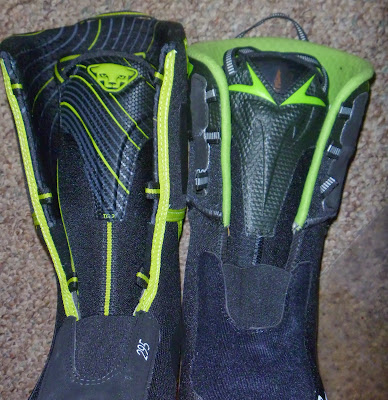
On the left is the TLT6 CR liner. PreviousTF-X liner on the right. Lower positioned sock "stop", fewer laces but covering more on the inner boot. Almost a full inch taller and a much beefier tongue. And still the new CRliner is 38g lighter.
That pretty much says it all. Newest liner is not much lighter but it is some lighter. Impressive with the added features and hight. I don;t question it will be themost comfortablefor skiing up hill or down. I am a big fan of the last generation of TFX lines as well. And as much as I like the original,the Palau TF liner, it could be more comfortable. I use an even lighter version in my PDGs and have similarissues on fit. Good but they could bothbe better. I have to use a customorthotic in both shells to keep my feet happy for the day. Easy enough to mix and match or add a after market liner. Be sure to heat form your liners if you want the very best fit. No matter what Dynafit suggests. If they can be molded...mold them. No one in their right mind would ski a Intuition without heat molding/forming them. Get on that clue bus for all of Dynafit's liners as well.
Comparing the TF-X liner to the the newest CR liner? Besides the drop in the weight on the CR you get a slightly taller inner boot, much more reinforcement in wear areas and a deeper throat for easier entry and exit. The laces have eyelets higher on the inner boot and lower as well. The idea is a better fitting inner boot. The tongue of the CR inner boot resembles a full blown ski boot now. It is stiff and reinforced although you have to look closely if you don't have it at hand.
The flex portion of the cuff is more flexible going back wards and as rigid or more going forward with a limiter strap on the back of the inner boot. Not sure it works as they intended but no question Dynafit has made areal effort at having offering amuchbetter all around inner boot.
Shell mods/boot fitting: At least now folks will not be so hesitant about blowing out the boots for fit issues. The metatarsal bellows made that all rather problematic on such a thin boot. A good boot fitter should be able to do it with rather easily now by comparison.
Variations? To date I have seen 5 versions of the TLT6. and 3 models. By levels of stiffness in the cuff material, more to less.. Carbon cuff, Fiberglass cuff and a Pebax cuff. Two liners, (maybe even three) which are the CR or Comfort Ready and the CL or Comfort Light. I am still a little unsure what we will see for actual liners but those are suppose to be their names with actual liners pictured below.

Photo courtesy of http://mountainski.eu/
TLT6 P CR
TLT6 P CL
TLT6 C-ONE CL
TLT Mtn CR
TLT Mtn CL
 Durability?
 Guy have been getting a couple of years from the boots generally.
Some are still on the same boots from Fall of . That amazes me. I am gentle on my gear for the most part and was worried about my own TLT5s in either version from theski cutting I experienced on theboot shell. I have been reassured the Grilamid is more than up to the task. But then I have neither the desire northe pocket boot to test them to failure. Seems a silly thing to worry about in a $1000 boot. I have not had problems with the hinge rivet however. Or the buckles for that matter other than not always wanting to stay shut.
The Buckles? The new buckle system for the most part are a nice improvement. More of them however. Still only 2 but they have added more adjustments and hinge points on the buckles that are there and an extra latch over the instep. Only a tiny gain in weight because of it. I really like the "snap" of the lower buckle and it now dbl pegs to lock it down. The first TLT had no peg on that buckle. The 2nd gen boots offered a single peg in the same buckle which helped. This new dbl peg buckle should have that issue sorted out. So I am hoping the instep buckle now stays shuton the crusty boot packs.The shell has a "dam" built around the lower instep buckle as well. That will help keeping the buckle closed as well.

Last year, Dane's new G20s and
a perfect fit!
Crampons? Grivels seem to be made for this boot. They fit like a glove out of the box. The others? Not so much. I've use the G20 and G22 on different occasions and prefer the G20s. Unusual as I am not generally a fan of mono points.
A BetterComparison?A better comparion now on ski boots instead of the TLT5 and 6 IMO is the TLT6 and the
ONE PF-
TX. Just
5.5oz/
156g between the two boots, and
$450.
It has been nawing at me for a week or so. I seem to rememebr Lou over at Wild snow "asking" for a TLT ONE at some point in the recent past. Without a doubt that is exactly want theTLT6 is now.
Not sure what the weight is of the third buckle and two added Pbax straps are. The liners are off by one ounce. Add the spoiler,bigger power strap and extra sole lenghtand the grams add up quickly.
Sometimes it is easier to just ignore the obvious in front of your eyes.
 More?I've written a lot on the TLT Series of boots over the last couple ofyears. If the TLT6 is your introduction to the TLT family you have some catching up to do. I have no doubt the TLT5 Series of boots was a "game changer". The TLT6 may well be yet as well. The jury is still out. More here:
http://coldthistle.blogspot.com//06/part-2.html
Finally?I am not a snow boarder but, I was directedto this comment and asked for a rebuttal if I thought it warranted. I'll insert my comments into the body of the original message.
thread in part is here:
http://splitboard.com/talk/viewtopic.php?f=10&t=10958&st=0&sk=t&sd=a&start=234
barrows sez:
>In my opinion, the 6s are going to be better. The only drawback I see is the additional 1 ounce of weight in the shell of the 6 vs the 5.
Actual shell weights with power strap attached
TLT6 P CR 1050g
TLT5 P TF 1010g
TLT5 Mtn TFX 1000g
50g is 1.7637oz per boot
>Personally, I would rather have the extra ounce of weight and the additional warmth and better buckles, both of which were weak points of the 5 which needed improving.
Buckles yes. Warmth?...not if the boot was used as intended and NOT for riding a lift. Classic case of using a piece of gear for something it was not designed for and bitching about it. It was originally designed as a Randoboot made for climbing and skinning UP and skiing DOWN.
>There is no need for the forefoot flex of the 5 in my opinion, in fact, the amount of flex was so miniscule (unlike the Scarpa) as to be almost non-existent anyway.
See my previous comments. Uneducated at best.
> As far as the liners go, all the Dynafit liners are weak
Again uneducated at best and simply untrue no matter what liner you'd like to compare with.
> I use Intuition for more comfort, warmth, and weight savings.
You might gain some warmth although I don't find that to be true if the boot is fitted correctly. No morecomfort either if the liner is heat formed correctly. And that weight savings? Ya, not so much.
TLT6 P CR 288g
TLT5 P TF 186g
TLT5 Mtn TFX 326g
DYNA EVO/PDG liner 150g
*Intuition Pro Tour* 278g
weight is listed for ONE liner boot
49g savings at most or 1.72842oz in my size 29s or a 11.5US with a Intuition. Or using the lwt Dynafit liners as much as 123g saved on the Intuition or 4.3387oz. And that is doubled counting both boots so just over 1/2#. That kind of weightstarts to really count on the up.
> The Dynafit Mountain was also never available in the US with the lighter (and better) Palau made TF liners
That is true but theTF liners alone have been available on occasion as is the Palau DyNA/PDG liner that will work in the TLT Series as well and only 150g.
>you could only get the heavy and less moldable TF-X liners
Ya, flatly untrue on "less moldable: The TFX liner is very moldable and actually more comfortable for most than the TF liner was. Which is the reason we have a new CR liner based on the TF-X liner in the new TLT6. Spares are available as well from your Dynafit dealer. See my previous comments on fit and liners above.
>As for riding performance: the 6 Mountain should be the same as the 5, as the cuff is the same plastic and mold, so will flex the same, and the no tongue option is still available.
Almost right :) The TLT6 liner is beefed up in the tongue quite a bit. Think more of a full on ski boot tongue in the 6. My long time climbing partner and avid snowboarder for the past 30+ years (and in the TLT5 mtn as well for a hard boot which is not typically his fancy)says it won't change how the boot boards very much either way.
Given the choice for a hard shell on a split board bootI'd want the PDG. 2# even per boot in my size 29. No tongue or power strap. It is too thin to ride a lift with on a really cold day. The PDGreally is a "ski running boot".


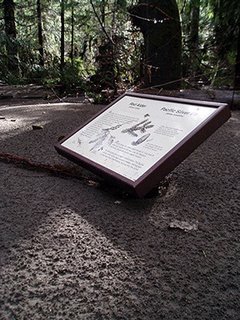 Snow is accumulating at Paradise. I measured 46" total, with 15" of fresh snow this morning. It looks and feels like winter and if the park were open, skiers, boarders and snowshoers would be enjoying the early snowfall. But the floods really did a number on the roads and as the days pass, it becomes more clear how complicated the damage is, especially with the prompt arrival of winter.
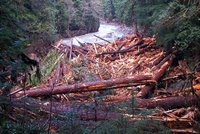 Here is the primary deposition zone for all of the timber that was unearthed in the same landslide.
 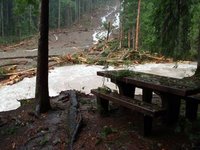 The river also moved and in doing so, took a couple of the campsites with it. Here is the new loop C of Ohana.
 I'm still wading through our storage shed and sorting through the hundreds of books we have left. I have a few sets of books that I'd love to pass along to someone that could use them. The first set is a Science series that says it is for ages 9-12. They are hardcover books, with a library binding on them and they are in great shape. The set is of the four seasons and fire and sunlight.
 If you own a pair of capri pants that are comfortable to cycle in, but you don't like the way the bottoms flutter in the breeze or get caught in the drivetrain, then here is a quick and dirty way to turn them into cycling knickers:
 You will need a long elastic band, which can be purchased at a shop that sells sewing supplies. Alternatively, you can use narrow hairbands, as shown above (these come in a pack of 10 that costs around $2).
 Check the hemming at the bottoms of the pant legs. Sometimes the manufacturer will leave an opening in the hemming, at the outer seam. If not, carefully create an opening. Don't cut into the actual fabric; just undo a small portion of the outer seam through which to thread the elastic. This was a quick and whimsical project, andI do not have a step-by-step photo documentation. But I hope these after-the-fact pictures adequately demonstrate what is involved.
 Once you have threaded the elastic through the hemming, simply tie it on the side so that it is snug, but not constricting. You can then choose to either hide the knot inside the seam and sew it back up, or leave the knot exposed. The benefit of the latter is that you can keep converting the pants back and forth between normal capris and cycling knickers.
 Aside from staying clear of the drivetrain, an additional benefit to these knickers is that you can continue to wear them in colder weather. Simply add long socks, and the elasticised bottoms will protect your legs from the wind. Cape Cod has greeted us with temperatures in the 50° F range, and it looks like I will be living in these for the next 2 weeks!

 "Colin Haley photo of Bjørn-Eivind Årtun unroped onthe Cassin, June ."


 A little heavy and too expensive, but one I keptand really like, but now use only as a ski pack, the Arcteryx Khazi 35.
 *1973*
 Custom red Ozones in **


 Custom Ozone made from White Widow Spectra Ripstop.


