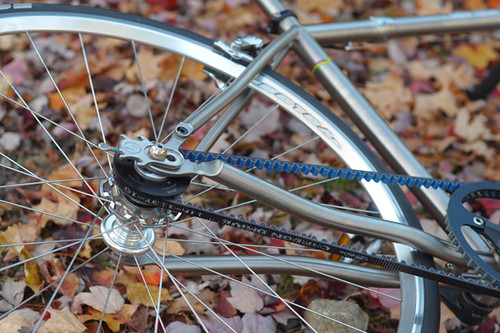
I've wanted to try a bicycle with a belt drive for some time, but they are not exactly mainstream around these parts. So when I saw a belt drive
SevenCafe Racer in my size at theRide Studio Cafelast week, I seized the opportunity and took it out for a ride. The belt drive Cafe Racer is a single speed version ofthis bike, one of
Seven's commuter models. I will save my impressions of the bicycle itself for a different post, focusing for now on my impressions of this unique drivetrain.
The belt drive is a product called theGates Carbon Drive-a polyurethane belt that replaces a traditional bicycle chain. Unlike a bicycle chain, the belt does not need to be oiled or otherwise maintained, which also means that it won't get the cyclist's clothing dirty. It is said to be longer lasting than a traditional chain. And it is silent. For these reasons, many praise the belt drive as a revolutionary innovation in cycling - particularly cycling for transportation.
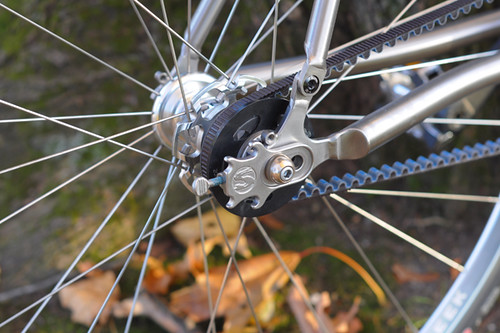
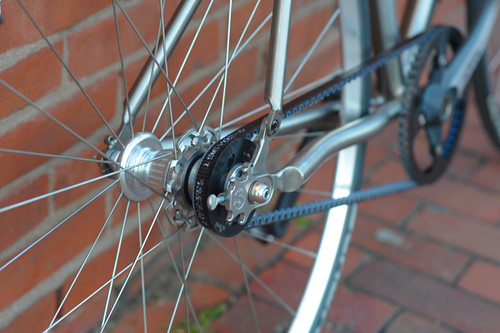
On the downside, the belt drive requires a dedicated split-frame construction; it cannot just be retrofitted on any old bike. This is because the belt itself, unlike a traditional bicycle chain, cannot be split apart. In the picture above you can see that the seatstay of the
Seven frame disconnects from the dropouts to make the belt installation possible (and that is a Surly Tuggnut chain tensioner they are using, in case you are wondering).
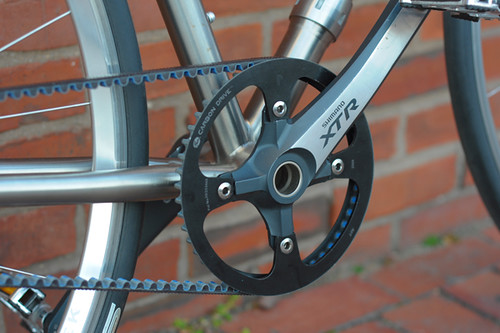
The belt's unique groove structure also requires it to be used with belt drive-specific front and rear pulleys instead of traditional chainrings and rear cogs. It is, however, compatible with standard cranks and hubs. The drive can be used with single speed and internally geared hubs, but not with derailleur drivetrains. As I understand it, it can be used with fixed gear and coaster brake bikes, as long as hand-activated brakes are present.
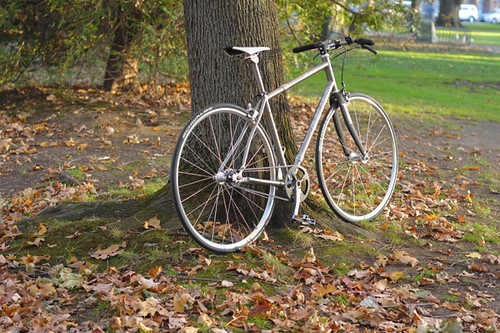
I rode thebelt drive Cafe Racer for 5 miles or so along the Minuteman Trail in Lexington and Bedford MA. Compared to a traditional chain, the belt felt smoother and "softer." It was a neat sensation, distinctly different from cycling with a normal drivetrain. On first impression, I would say that it felt nicer. Although some describe the belt as silent, I would not say that exactly. It was definitely quieter than even the quietest traditional chain. But it made a gentle "swooshing" sound that I could hear whenever my surroundings grew silent. Additionally, I am pretty sure that I could feel something happen in the drivetrain at the end of every crank rotation. It was the subtlest of sensations, but definitely there. It was almost as if the belt had a seam in it, and I could feel when that seam went over one of the pulleys.
To be clear, neither the "seam" nor "swooshing" were something I would have noticed, had I not been intentionally paying very close attention and trying to take in every single aspect of the belt drive experience. They were more like ghostly traces than full-fledged sensations.
Prior to trying the belt drive myself, I'd read and heard a number of impressions from others. Alan from ecovelo is probably the "king" of belt drive test rides; he has tried at least half a dozen different bikes with this system and loves it. On one of his personal bikes, the belt drive has worked reliably for him for some time. Others (including commentators on
ecovelo posts and persons I've spoken to locally) have reported a number of issues, such as squeaking noises, the belt slipping, and the system performing sub-optimally in winter conditions. I think that in order to get the big picture of how the belt drive performs, we need to wait until more cyclists use it for considerable periods of time, in different climates and weather conditions, and on a variety of bikes.
Next month I will be receiving another bicycle for a long term test ride that also happens to have a belt drive. No doubt I will have more to say after a few weeks of real-world experience with the system; maybe it will even start snowing by then. In the meantime, I am glad to have tried it on a different bicycle first - having done so will allow me to separate the feel of the belt itself from the feel of the specific bike. As far as first impressions go, mine are positive and I would love to see a classic city bicycle fitted with the
GatesCarbon Drive... speaking of which, why do we never see that? The belt drive seems best suited for everyday commuting, yet most bicycles I see fitted with it are "weird" and "techy," if you'll pardon that biased terminology. An elegant belt drive city bicycle would be a delight to try.


 BD Serac crampon on water ice


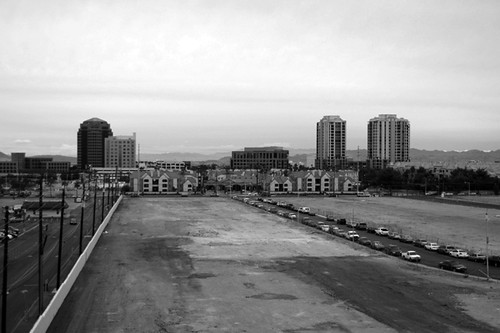 Though I've lived in many different places over the course of my life, they have been mostly in Europe. Within the US my travels have been limited to the East Coast, and my trip to Las Vegas for Interbike was the first time I'd ventured west of Pennsylvania. Popular culture is saturated with images of Vegas, and I thought I knew pretty well what to expect: casinos, bright lights, neon signs, drunken merrymaking... If in the right kind of mood, I could see the kitsch appeal. But what I did not expect were unfinished construction projects, miles of empty parking lots, and a funny sense of being in the middle of a Broadway production that had its funding cancelled before the set could be completed. Maybe I wasn't supposed to arrive during the daytime (or be awake during daylight at all while there?), but the Vegas I saw looked not unlike the outer boroughs of former Soviet bloc cities, with their faded concrete high-rises and muddy vacant lots.
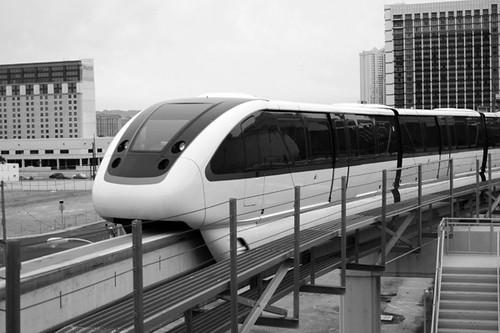 Equally fascinating was that Las Vegas seemed to be intentionally "anti-pedestrian" in design. I have no background in city planning, so it's hard to explain exactly what I mean. But with the exception of the smallish main strip - which is indeed walkable and feels like Disneyworld on crack - the city is made of these self-contained complexes accessible either by car or Monorail (they really try to push the Monorail, but it was mostly empty every time I used it).
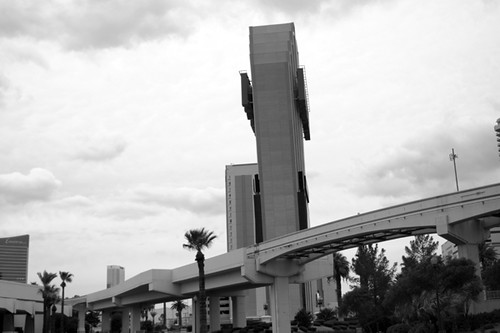 Even in the city center, the roads are multi-lane and highway-like. Sometimes there are sidewalks, but they are lined with tall guard rails and there are no provisions for crossing the street except maybe every mile or so.The hotel I stayed at was technically around the corner from the convention center where Interbike was held, yet it was recommended I take the Monorail to it. Well, one night I had this crazy idea to walk. I could clearly see the hotel right in front of me - how bad could it be? It took about an hour and a half, because there was no way to walk to it in anything resembling a straight line. I had to walk around stadium-sized empty lots surrounded with chainlink fences, and when I tried to take shortcuts through hotels, I was forced to navigate along winding paths designed to maximise my exposure to slot machines. It was surreal. As for riding a bike, I remember someone posting a ridiculous statistic on twitter, claiming that 100% of Las Vegas residents who cycle report being hit by a car at least once. Having now been there, I no longer find it implausible.
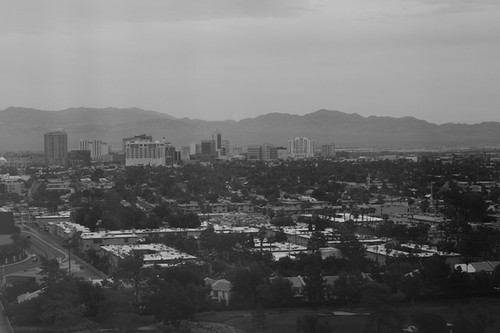 While of course I've known that places like Las Vegas exist, I guess I've done my best to avoid them - choosing to live in areas that are walkable, which for me equates with livable. Being faced with the reality of what a city like this is actually like was jarring. I know that places like Boston comprise only a small fraction of the American urban landscape, while a model similar to Las Vegas is more common. I know it, but I try not to think about it, because the realisation fills me with a dread that I don't know how to overcome.

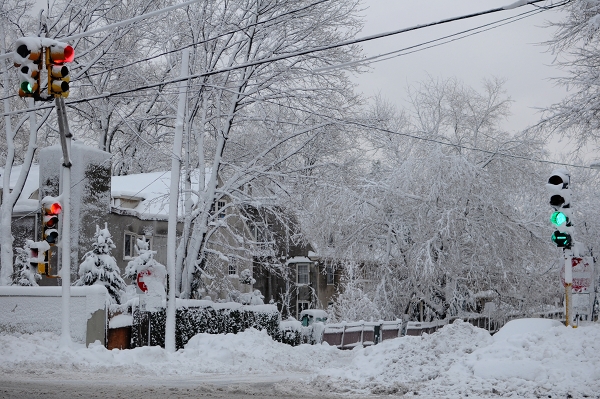 Yesterday's blizzard delivered even heavier snowfall than the first one we had, but our neighbourhood was a lot more functional and lively this time.
 The Co-Habitant cycled to work as usual, but I set off on foot. Upon reaching the main road, I was surprised to see many other pedestrians trekking along it. There are some small grocery stores and restaurants along this street, so the trekkers must have been heading to and from these establishments.
 This particular place of business was especially popular!
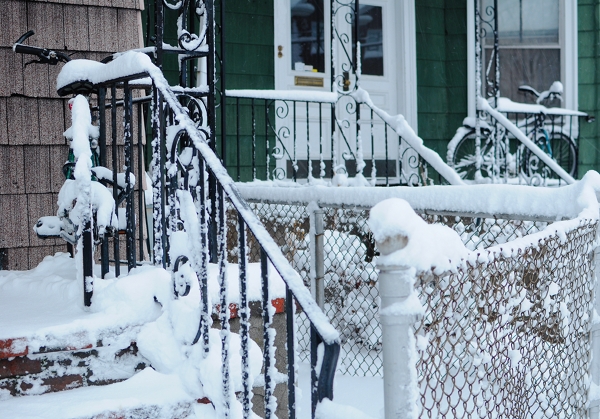 Lots of bikes buried in the snow, but I saw only two on the roads.
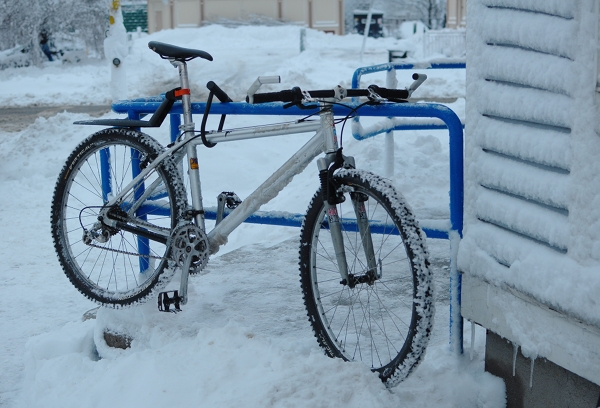 Mountain bikes are useful in these conditions - though the Co-Habitant says his Pashley handled fine as well. Apparently people photographed and videotaped him as he cycled to work.
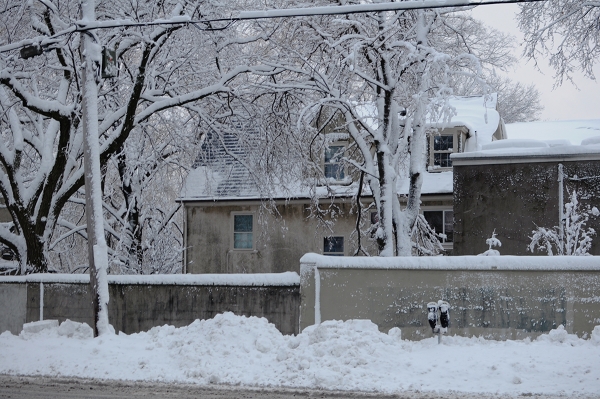 Given the conditions outdoors, I was truly impressed with the relative normality of everything.Many businesses and institutions were open, people were out and about, and fewer things were cancelled than last time.In the morning, the electricity went out on our street for a few minutes, but then came right back on. And the lock on the outside door was frozen when I came home, so I had to work on it for a while before I could fit the key in. But other than that, we had no blizzard-related disturbances.
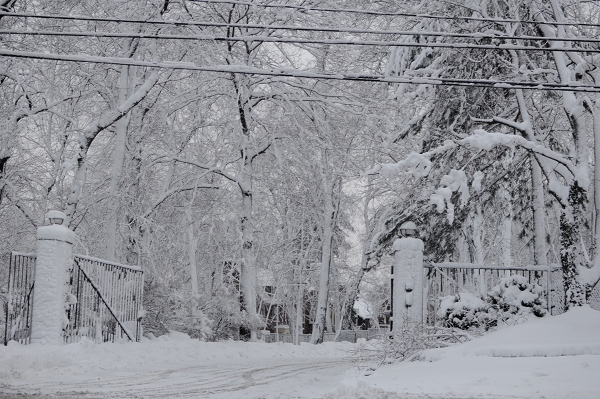 It is fascinating to me, that after only a few weeks of heavy snowfall my neighbourhood has already adapted to the new circumstances and normalised them - human beings are resilient! The atmosphere felt relaxed and not at all apocalyptic; it was a functional blizzard. And if this sort of thing continues, I will have to reconsider snow tires: Even the plowed parts of the roads were covered with at least a thin layer of snow. Turning the bike lanes into ski lanes would also work for me, but somehow I don't see that happening quite yet.