I added a third shortly after:
http://coldthistle.blogspot.com//01/a-third-shell-material-westcombs-focus.html
Any of the threecan be easilyused for most anysport where you need someprotection from nasty weather,including climbing. In the case of my buddy Dave and I, ice climbing for sure but lift/side-hill on a snow board or skis as well or a quick run on the bikes.
It was no accident that we both showed up for a reunion at our once home townski area kitted in similar gear. Even though I was skiing on lwt Dynafit gear and Davewas on a snow board we would be on the same terrain. Do this stuff long enough and there ends up being a well thought out and comfortable"uniform" fora goodday out. Matching colors with your Bro? That is just a little weird!
David and I have been playing on this particular ski hill together almost longer than I can remember. I do seem to recallusteaching basic search and rescue techniques to the volunteer ski patrol bitd and ripping it up around them on 3 pin tele gear though. GearI amhappy to see long gone from mystorage closet!

Below: Dave in his Arcteryx Alpha FL leading

Arcteryx Alpha FL shown above
10.7 oz. for a Men's Large, $400
Two different Goretex fabrics:
2.4 oz Gore Active Shell, 2.9 oz Gore-Tex Active Shell reinforcements
a very light Goretex shell

Below: Dane leading in his Westcomb, Shift LT.

The Westcomb, Shift, shownabove
11.9 ounces for a Men's Large, $400
Two different Neoshell Fabrics:
340 NRS Polartec® NeoShell® - Fly weight nylon ripstop and 360 NP Polartec® NeoShell®
Lightest Neoshell to date
Although I have likely climbed more ice in a hard shell than any other pieceof clothing, today a hard shell is one of my least favorite garments to use. More likely one I would use skiingthese days, so I can dress downfor a good work out and stillcut the wind chill.
But if you are going to climb in a hard shell the newest Gore and Polartec "hard shell" technologies are actually pretty spectacular. There is a light weightEpic shell that will be here soonthatwill make a goodcomparison to these two. That shouldbe interesting.
Before I offer some comparisons on these two how about some back ground? BITD (as in back in the day) belay jackets were rather unheard of. We had big jackets but few of the guys I climbed with ever bother to bring one. We dressed in the morning with what we thought we might need for warmth that day. May be a extra layer to go under our shell (likely apile jacket or down vest) but not likely one to go over it. Basically you assumed you would suffer, too hot when you were working hard and too cold when stuckwhile belaying a slow lead. You learned to climb fast for all the obvious reasons.
No one climbing ice seriously back then would ever tolerate a gumbie gettingon and then lacing up an ice climb like it was a rock climb in the sun. That same thing is socommon now. Couple of reasons for the lack of empathy back then. Few ever carried more than a 10 or so ice screws. Screws were justtoo hardto place even in the best of conditions. The other was yousimply didn't get on climbs you weren't technically capable of. Experience taught you and your partner that. Falling on ice was simply unacceptable. You ran out ice climbs, just to keep everything moving and everyone warm. I've had several painful reminders of how not to ice climb, when Dave can't come out to play.
When you are climbing within your skill level you can move quickly and carry little gear all while staying warmer.
The first one day ascents of GCC on Kitchener, the Super Coulior on Deltaform, Slipstream, Teardrop and Polar Circus were all done in a similar manner. Hard shells, no extra clothing. tiny packsand climbers performing well within their skill levels.
No surprise the skill levels have changed. The technical difficulty at which thecurrent generation of climbers are capable of is simply amazing within that perspective. Their ability to get above their own pro...not so much.
It should be no surprise then if you want to climb light and fasta hard shell built to exacting standards and lacking many of the modern accouterments some require is still a good choice for most conditions where ice is involved.
When Dave and I kitted up on the Parkway last week, we were both in soft shell pants, a moderate amount of base layers, little insulationand hard shell jackets. I used the Shift LT,Westcomb's new light weight (the LT), sewn from two types of Polartec's Neoshell. Dave showed up in theArcteryx, Alpha FL (fast and light) , using two weights of Goretex Active shell. The jackets are very, very similar in design and function. Which made for some easy comparisons.
What does all that mean to you? Either is a nice "action suit" jacket but not much reallyin actual differences. More differences in the pattern cut imo than performance. But no question, there are differences in performance. Lets talk pattern first. The "FL" designation from Arcteryxstands for "fast and light". Fair enough, the jacket deserves that kind of label. Not sure or care who got there first but the Westcomb Shift LT is equally "fast and light". Jackets might as well be clones of one another. Same single chest pocket and helmet capable hood. Greatfit on both hoods with a helmet. I find the Westcomb patternfits me in a large better than the Arcteryx stuff generally does in a Large. The Westcomb stuff is cut a little bigger in the shoulders and arms.I am thankful for the better Westcomb patterns (for my body shape anyway) as most every new shell my size I try onthese days seems to have arms the size of a #2 pencil. I'm 190# and 6'1". That forces me to get the next size up in a lot of clothing. But Dave (who is almost skinny) at 185# and 6'3"loves the fit of a size large Alpha FL. Both have long tails that stay tucked into a harness. The sleeves are long even when you are full stretched out and seal well under or over gloves. Perfect! We can easily move along from all that now.Find the one jacket that fits you the best, would be mysuggestion.
Performance of the shell fabrics?
Goretex has an enviable reputation of cutting the wind and keeping you dry. The Alpha FL does both. The Shift is currently the lightest Neoshell garment yet made. And IMO it shows. Awesome jacket for sure and I love climbing in mine. You will stay dry from the inside or the outside. The newestNeoshell material, like the newest Goretex stretches a bit. But while I think the Neoshell breaths better under a heavy work load I also thinkthe Goretex is more wind proof.
We were climbing in the minus mid teens Celsius. I've recently learned that jackets that are less than 100% wind proof are chilly. My Shift was perfect for leading. But I wanted toquickly get onmy belay jacket (which is wind proof) when I wasn't leading. With the samebase layers and very similar insulation under our shells, Dave wore a belay jacket once in several days of climbing. I wore mine at every belay, every day we were out, if there was any sort of wind. Some of that can be tossed to my"new" body reacting poorly to the cold these days. But not all of it.
So what did I really think? I like the bright yellows and green color combos on both jackets. When I was cold in the wind, rightfully or not, I liked (envied)the Goretex version. When I was pumped stupid and sweating bullets I preferred the Neoshell. I sure dried out fast! Truth is it all boils down to fit for me. The Westcomb fit me very well in a large. The Arcteryx didn't in a large (too small or a XL. too big). That is a pretty common issue for me..similar thing happens withsome of the Patagonia clothing.
Both fabrics are really really good for what we were using them for, which was ice climbing. May be even betterfor skiing and snow boarding is my thought.
Figure out what you need for clothing and what will fit into your own system. Then find the garment that has a pattern that fits you the best with those same qualities and features. Honestly? It is pretty hard to go wrong with so many really good choices. If you screw it up first time around you'll are just as likely to learn how to climb faster or suffer more. How bad can it really get :)


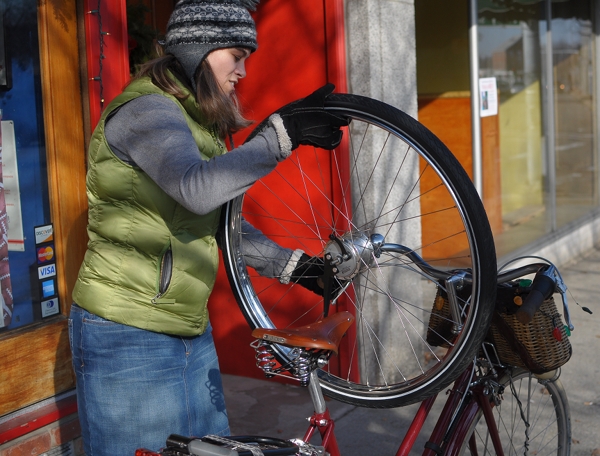 Even though we live close to one another and normally cross paths on our own turf, this weekend I bumped into "cycler" from Biking in Heels 10 miles away - at Harris Cyclery. We'd both taken on projects that ended up throwing us curveballs, and now here we were. Even if you work on your bike yourself, it's good to find a trustworthy bike shop you can turn to just in case - and better still, a specific mechanic whose opinion and work you trust. The fact that I travel 10 miles to see Jim even though there are plenty of bike shops walking distance from my house, speaks for itself.
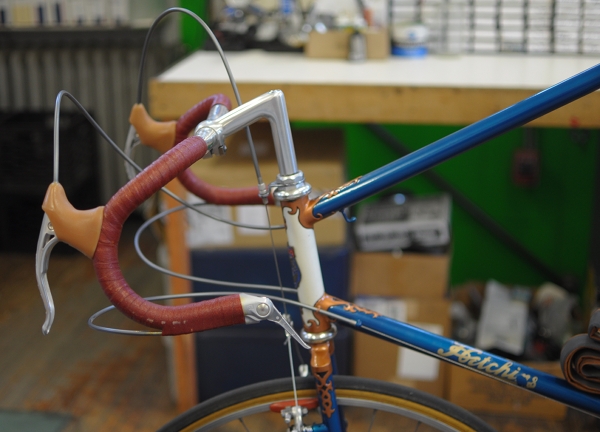 And if you are going to visit your local shop with a "project bike," there is no better time than the winter months. In the off season, bicycle shops tend to be less crowded, which means that they will be able to work on your bike sooner and will have more time to answer your questions. They are also more likely to have the components and accessories you want in stock, since things don't sell out as quickly as in the summer.
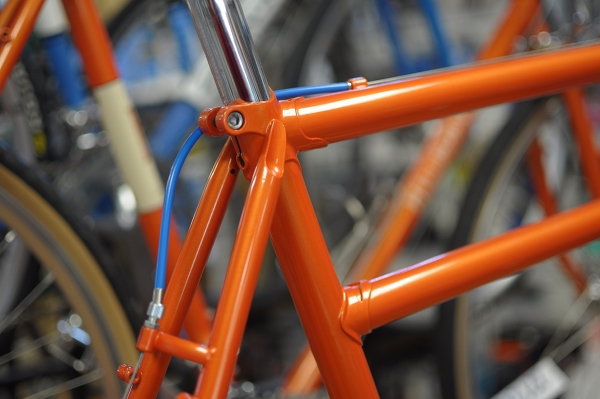
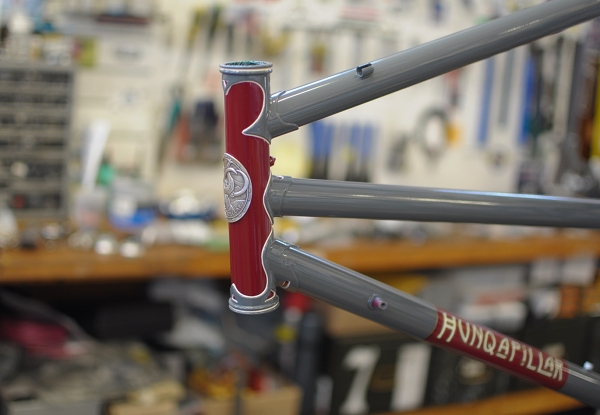 Some new floor models are likely to be available as well, since the shop will actually have time to build them up. This is the first time I've seen theRivendell Hunqapillar- the version with the diagonal "middle tube." The design is definitely not for me and I cannot help but wonder how many people buying this bike will actually be using it in a way that necessitates this construction. But I do appreciate seeing the monsterin person. The wooly mammoth headbadge and the decals are nicely done, as is the lugwork.
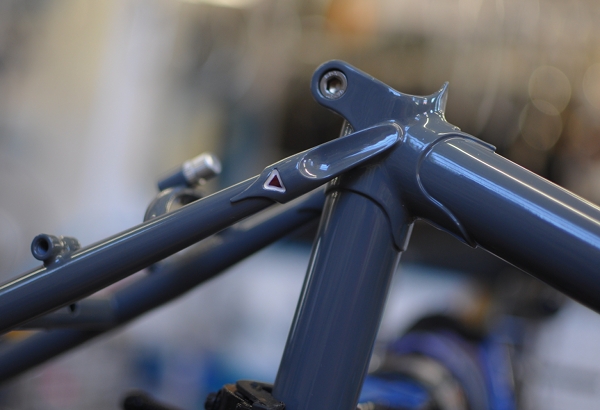 Never seen a seat cluster with a "socketed" seat stay like this before. Any idea what the purpose of this design is, assuming that it is more than aesthetic?
 Between the Hunqapillar, the flock of otherRivendells, the vintageHetchins, and other exotic specimens, it felt as if lugwork was declaring war on modern bikes and taking over the shop. My own modestly lugged bicycle seemed like an underachiever in comparison - though he held himself proudly and was quite happy to have the mechanic's attention.
 Winter is also the time when bike shops hold end-of-the year sales, where good deals can be found if you are in the market for a new bike. And for those manufacturers whose models do not change year to year, winter is often the last chance to get a bike at the current price tag, before prices go up in the Spring. If you hang around long enough, you might also learn about non-advertised deals, including second hand bikes. Some of the most interesting vintage bicycles never make it to the likes of Craig's List or e-bay, but are sold via word of mouth. Bicycle shops can act as hubs for those types of connections. If you are looking for a particular bike, try asking your bike shop about it - they might just know of a customer, or a friend, who is trying to sell theirs.
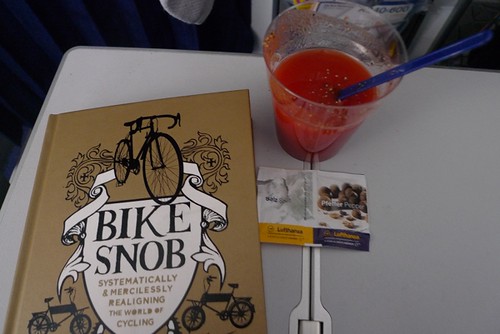 Leaving for Austria again, I bought the new
 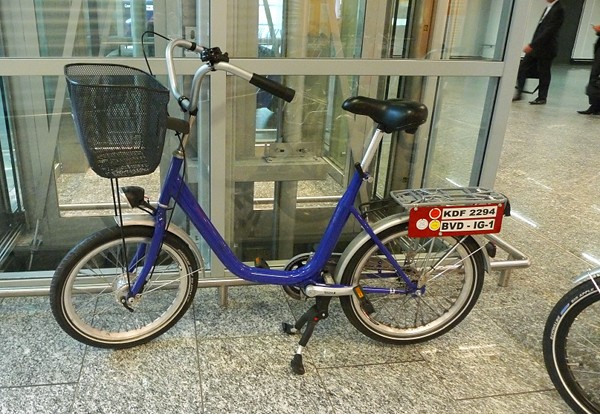 In other velo-news I can report from my travels, I saw these neat bicycles during my layover in Frankfurt Airport. These bikes have fenders, dynamo hub lighting, a the double-legged kickstand, a bell, a Basil front basket, a Pletscher rear rack, Schwalbe tires, and what appear to be license plates. From what I could tell, they are for the airport employees and not for flight passengers. Too bad, I would have liked to ride one around the airport!



 Can you spot some of the, erm... unusual updates?
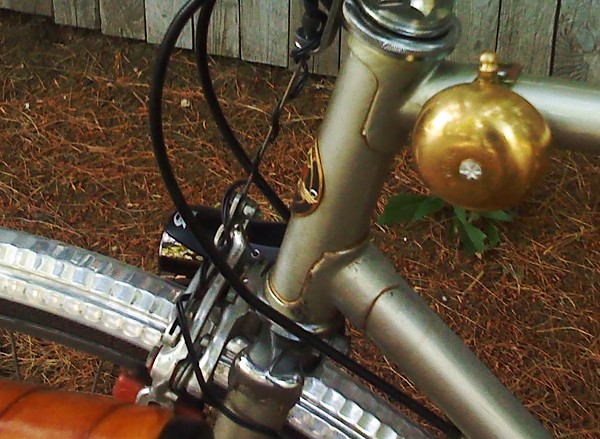 First, there is the bell mounted on the top tube. Yes, the top tube. An eccentric choice, but I think it looks distinguished!
 Then there is the computer on the handlebars. The juxtaposition of the computer and the twine makes me giggle. In return, he threatens to put one on his
 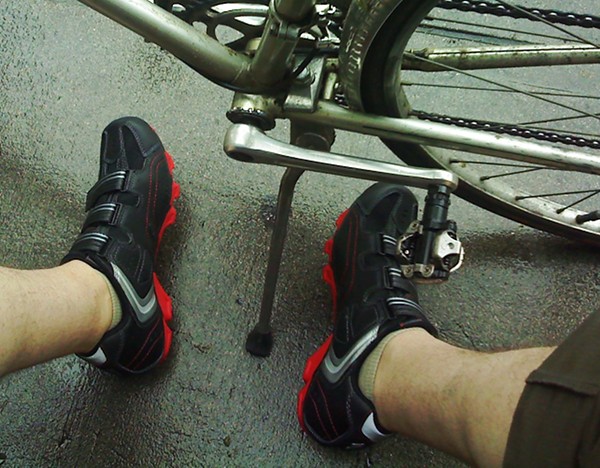 And, Oh God, what's this? He installed clipless pedals (SPD 520) and bought clipless cycling shoes to go with them. Madness!
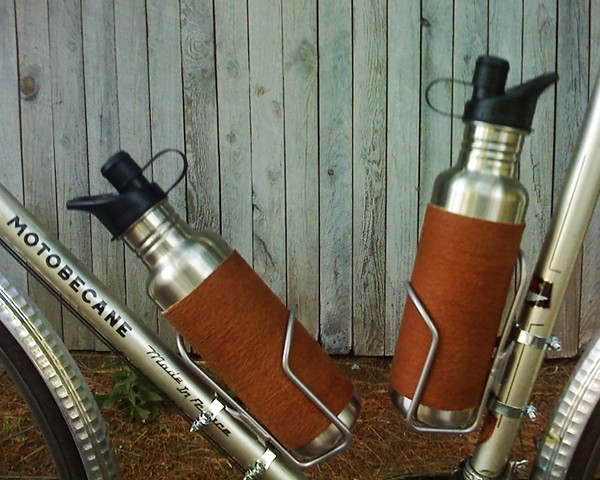 Of course, you've probably noticed these. Yes, they are twin, fully twined water flasks - with sports sprouts, or whatever those things are called. Spectacular, no?
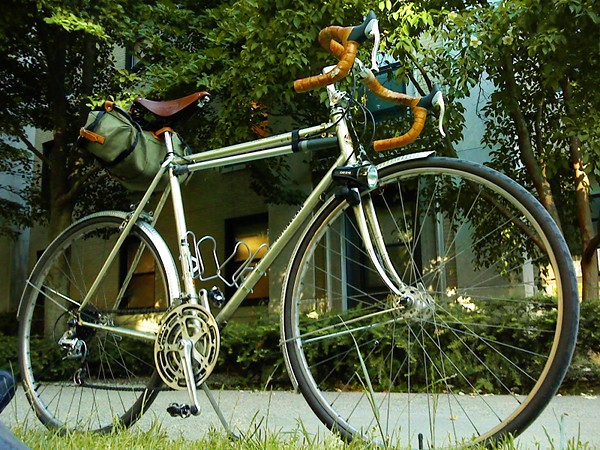 And finally, behold the


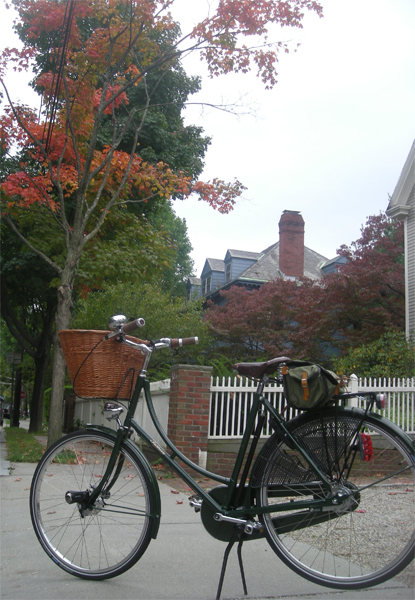 Having returned to Boston from our stay on Cape Cod, we were greeted by the "Leaf Season" in full effect. It happens so fast! This is very new for
 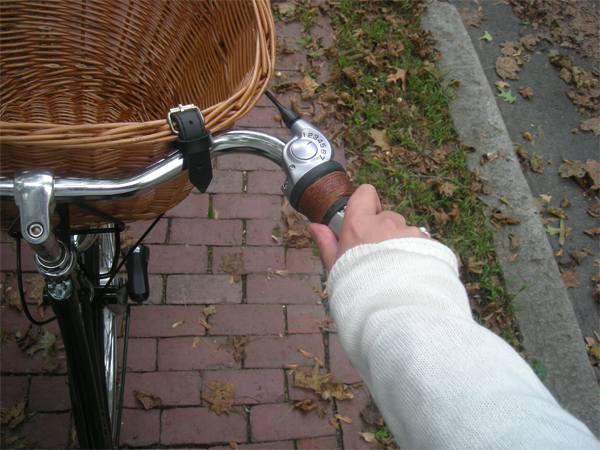 This is the fist time I have ridden my Pashley in over two weeks, and the absence made me hyper-aware of the differences between her and my Motobecane mixte. To my surprise, the upright sitting position took a bit of re-adjusting to: To be completely honest, I was somewhat frustrated with the bicycle's composed and stately demeanor after having grown accustomed to the faster and more responsive mixte. Also, I do not have a front rack or basket on the mixte, so another thing that took some re-adjustment on the Pashley was the enormous basket obstructing my view of the front tire.
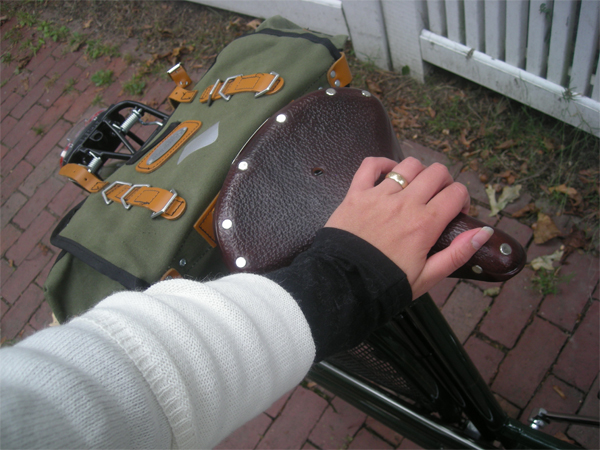 It was a crisp Autumn day, and it felt oh so cozy to glide through the streets in my soft, flowing cream sweater upon the nicely broken in leather saddle.
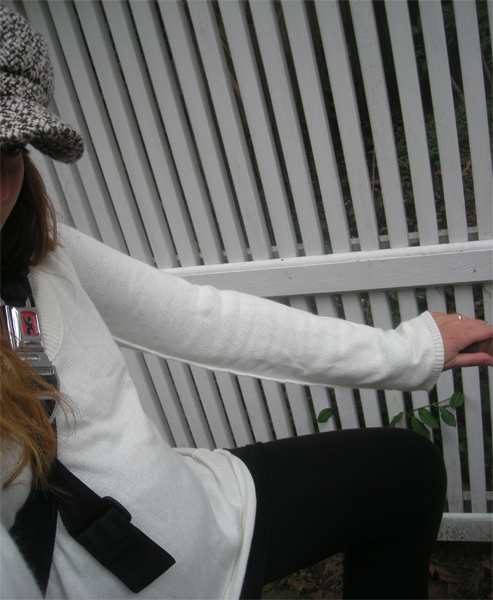 I tried to capture the sweater here, but this wasn't my day for successful self-portraiture. Wearing it made me feel as if I were officially acknowledging and celebrating Autumn.
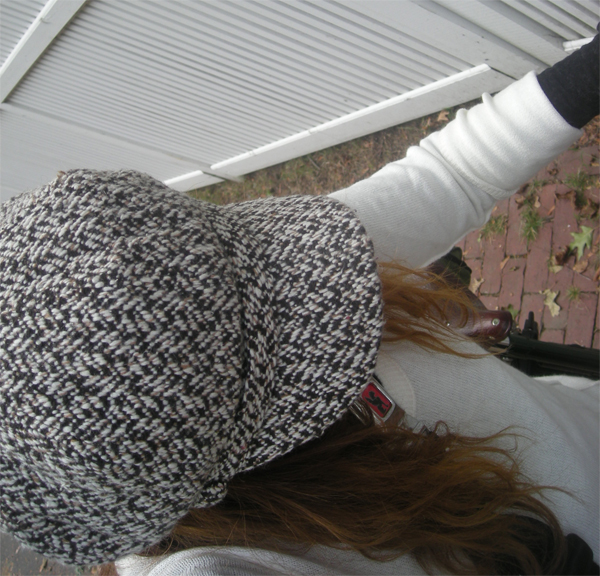 Tweed hat, bought at the Provincetown Army/Navy store - my current favourite cycling cap.
 And an attempt at a "Panda shot". Not very informative I admit - but hey, it captures the moment. Happy Autumn cycling!
 My campsite at Crooked River State Park. The tent was purchased that morning. After coming back to the campground the previous night and finding someone had pulled their rig into my site (even though my tag was on the post and my bicycle chained to the picnic table), I decided that I needed a “presence” in camp even when I wasn't there. It's been a godsend, especially with the cool/cold weather. A small electric heater makes it a cozy place in the evenings. And, no, I don't sleep in the tent – a cot and warm sleeping bag in the van are my nightly resting place.
 A tree is a tree. But these are at Crooked River. Really.
 The roots of a tree that was long ago downed, by what? The forces of Nature or those of Man? Even in “death” it is Magnificent.
 A palm frond, after the rain.